Hexapod Rescue Robot — Unit Robotika ITB
An autonomous six-legged search-and-rescue robot for the Indonesian Robot Contest (KRSRI). I worked in the electrical division from first assembly to competition: gait, sensors, wiring and the STM32 control architecture.
- legs, fully autonomous: nothing is remote-controlled
- 6
- legs, fully autonomous: nothing is remote-controlled
- on the team, Aug 2021 – Feb 2023
- 2 years
- on the team, Aug 2021 – Feb 2023
- contest objectives met in the 2023 regional round
- 1 of 6
- contest objectives met in the 2023 regional round
Context
ITB robot team "Viva La Ganesha", electrical division, 2021 – 2023. Indonesian Search-and-Rescue Robot Contest (KRSRI), Kontes Robot Indonesia. The 2023 theme was an autonomous legged robot for post-disaster rescue, and the regional round was held online on 30–31 May 2023.
The task
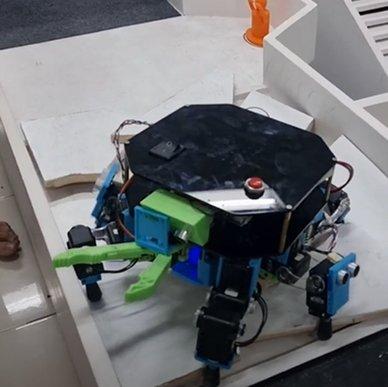
An autonomous six-legged robot leaves its home area, crosses an arena of slope, cracked-road, rubble and mud obstacles, lifts a miniature victim, clears stones from the safety zone, moves the victim to safety and reaches the finish. Nothing is remote-controlled, so locomotion, sensing and control all have to work together on one battery.

My contribution
- Locomotion: developed and tuned the six-leg walking gait on the arena obstacles. The 2023 robot walked straighter than the 2022 one, but its gait stayed inconsistent from run to run
- Sensors: chose and integrated ultrasonic range sensors for navigation and wall following, and an AMG8833 thermal array for flame detection after infrared ranging proved unreliable near the flame
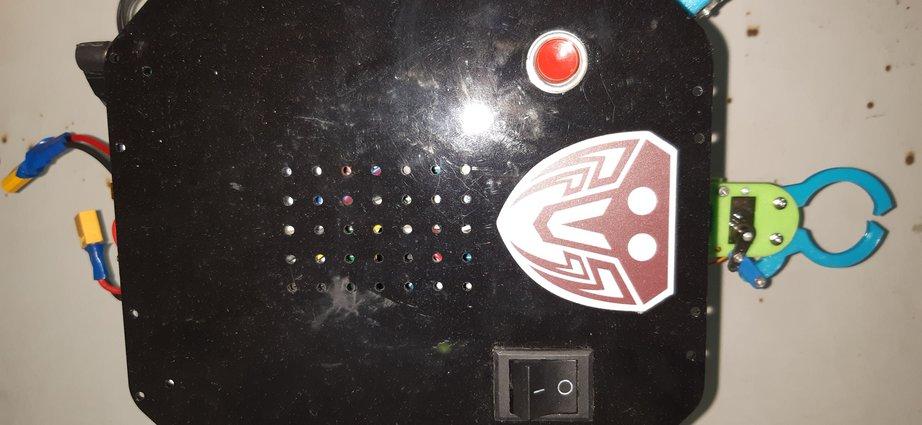
- Assembly and cabling: battery, power switch, fuse holder, boost converter, quick connectors and braided looms, designed so the robot could be taken apart and rebuilt quickly
- Control: built the STM32 master–slave controller architecture, worked on its PCBs, and wrote the code that drives the leg servos and reads the sensors
- Trial and error: balance, wall following and obstacle crossing were tuned by repeated runs on a practice arena, in about two months of build time that overlapped exams
Outcome
The robot left home on every attempt and walked straight, meeting 1 of the team's 6 objectives. It did not cross the first cracked-road obstacle during the contest, although it had crossed it several times in testing and again right after the second run. The gripper failed to lift the victim on both days despite a redesign for day two, and the team did not advance to the national round.
Lessons
- Current limits are a design constraint. The boost converter failed close to the contest after a servo-code change raised the peak current, and the battery was too small to reach the finish. I now treat torque, current and power limits as part of the controller design.
- Open-loop motion is fragile. Movement depended on the start position and was not repeatable. This is why I want to build state estimators and closed-loop control for robots like this one.
- Passing in testing is not passing on the day. Measure each run and change one thing at a time.